Outrank does one thing well: it removes you from the content loop entirely. If that's what you need, it delivers. If it isn't — if you want to review drafts before they go live, own your link profile, track your brand in ChatGPT or Perplexity, or use a CMS Outrank doesn't support — the platform's design works against you, not for you.
This list covers ten tools that replace what Outrank can't flex on. Each one is chosen for a specific gap in Outrank's model. Start from your reason for leaving, not the feature tables. For a broader shortlist, see our guide to SEO automation software.
Why People Look for Outrank Alternatives
Outrank's model is coherent. The problem isn't that it's a bad product — it's that it makes three structural choices that aren't settings you can disable. Once you understand them, the migration decision tends to make itself.
Auto-publish ships by default. Review costs $1,399/month.
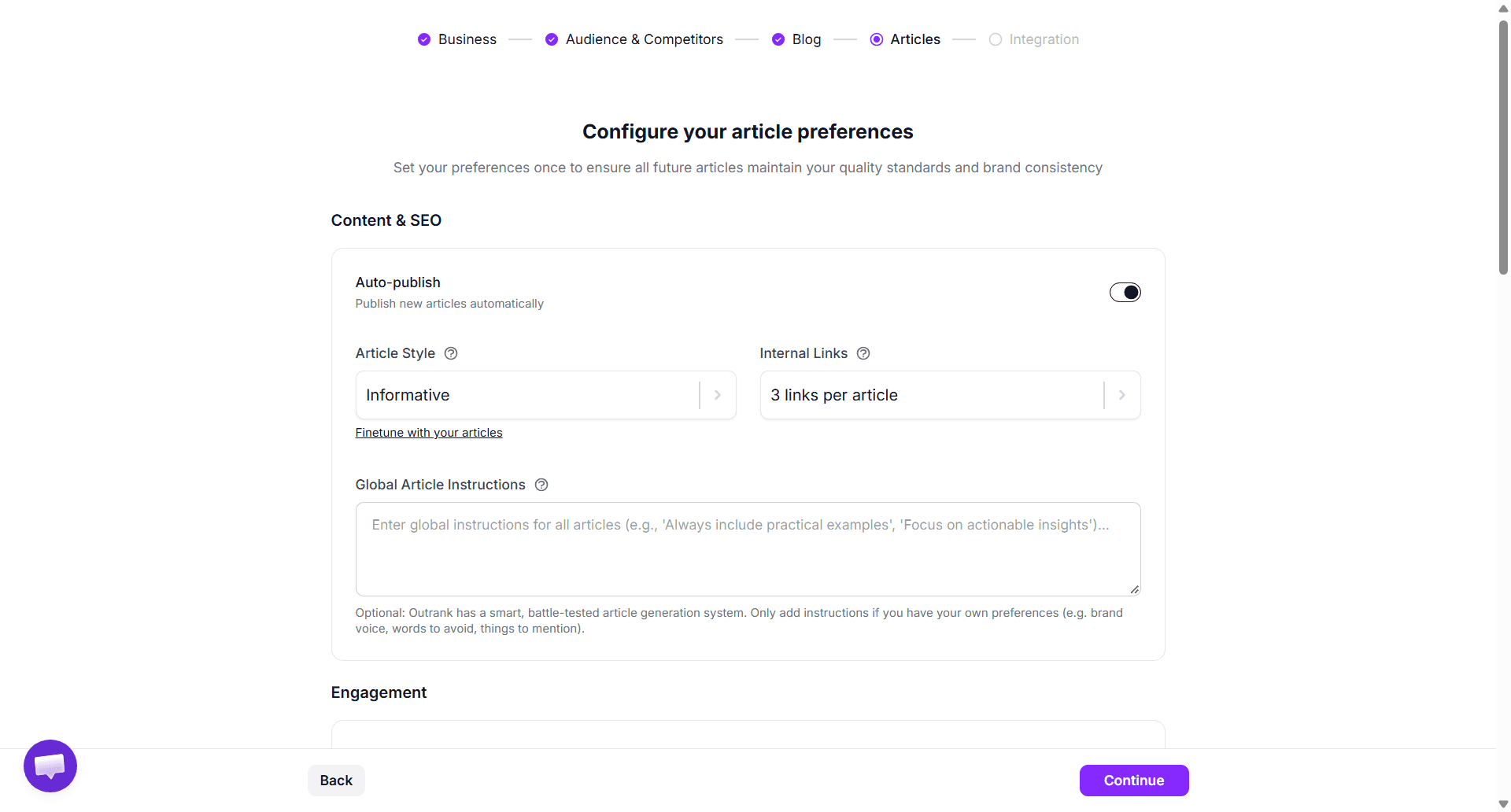
Outrank's five-step onboarding moves you through Business → Audience → Blog → Articles → Integration. By step 4, the auto-publish toggle is already on — "Publish new articles automatically." There is no "review first" mode in the base product. Human editorial review — where professional editors check and fact-check articles before they go live — is a separate service priced at $1,399 per month.
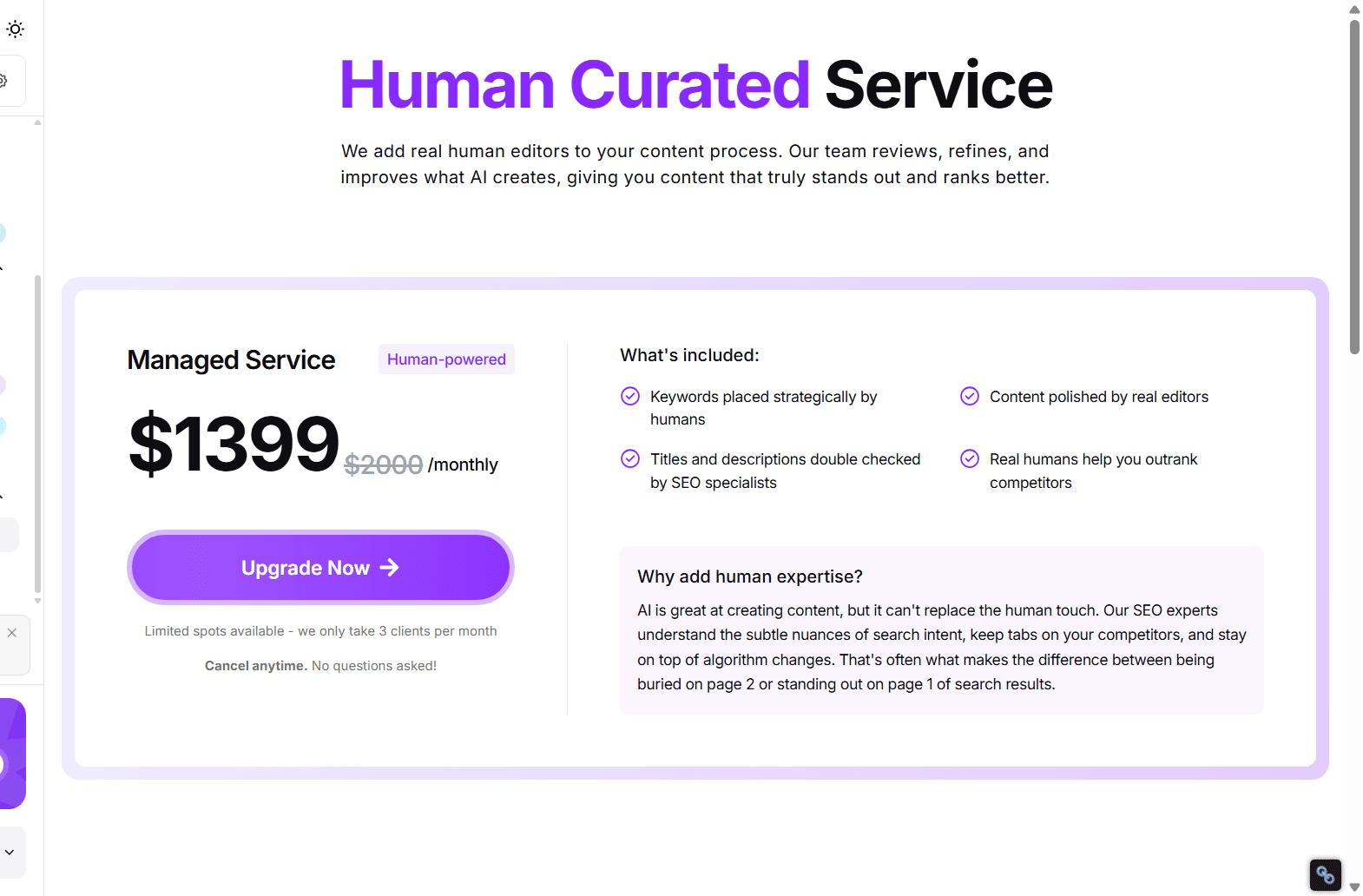
For teams with editorial standards, brand guidelines that need consistent enforcement, or any legal review requirement, the gap between $99 and $1,399 is the actual product decision. Most teams searching for Outrank alternatives are somewhere in that gap: wanting more than pure automation, but not at enterprise pricing.
The backlink exchange is built in, not a feature you opt into.
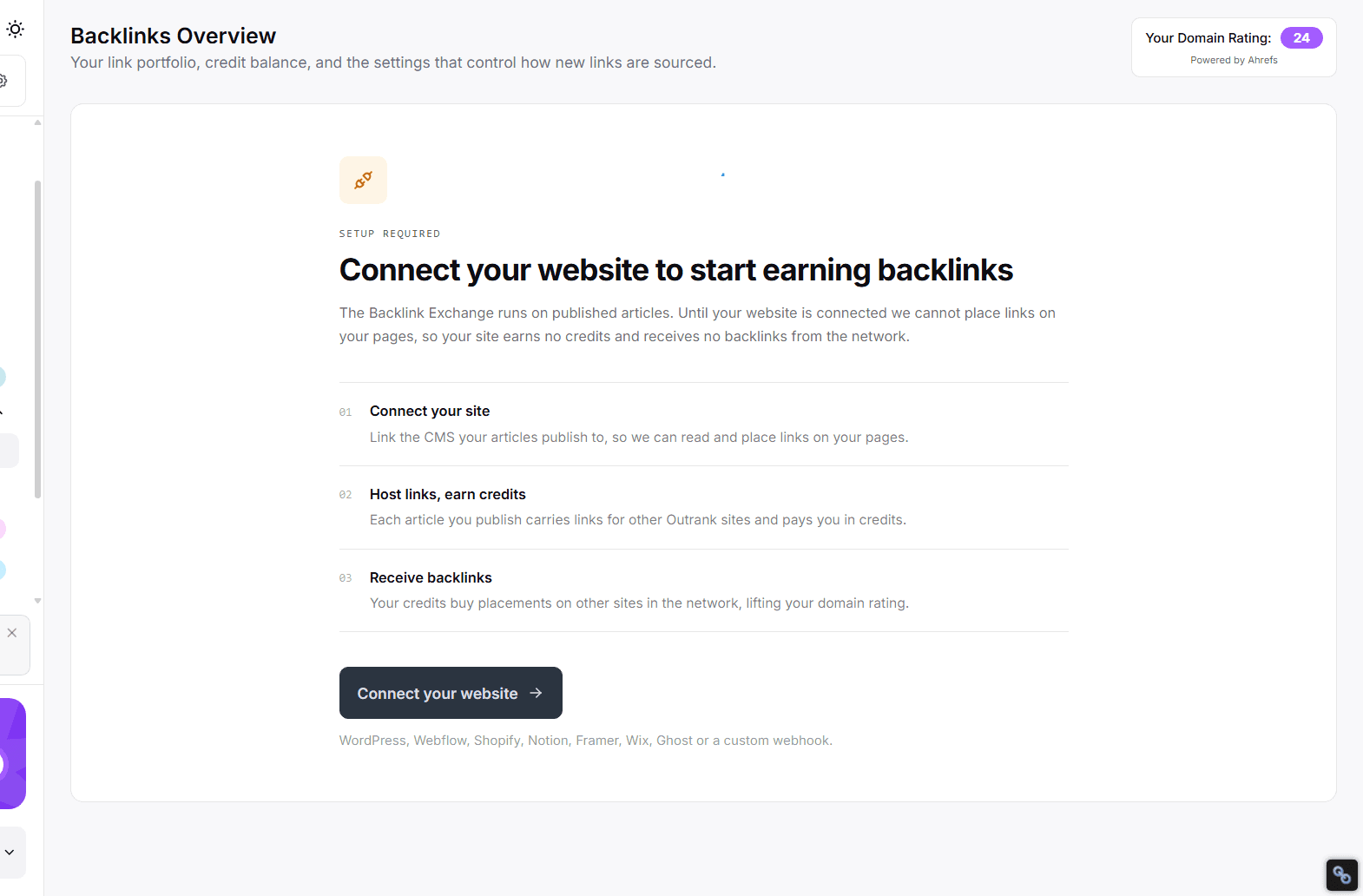
The Outrank sidebar shows a "Backlinks" section with an Earn badge visible during onboarding. The mechanism: to earn credits for backlinks to your site, your published articles host links to other Outrank members' sites. Outrank's own terms confirm there is no manual preview or approval step for those backlink placements. This isn't a toggle — it's how the backlink layer works by design.
For solo founders comfortable with the trade, that's a reasonable deal. For agencies managing client sites with strict link policies, or brands where every outbound link needs approval, it's a structural mismatch.
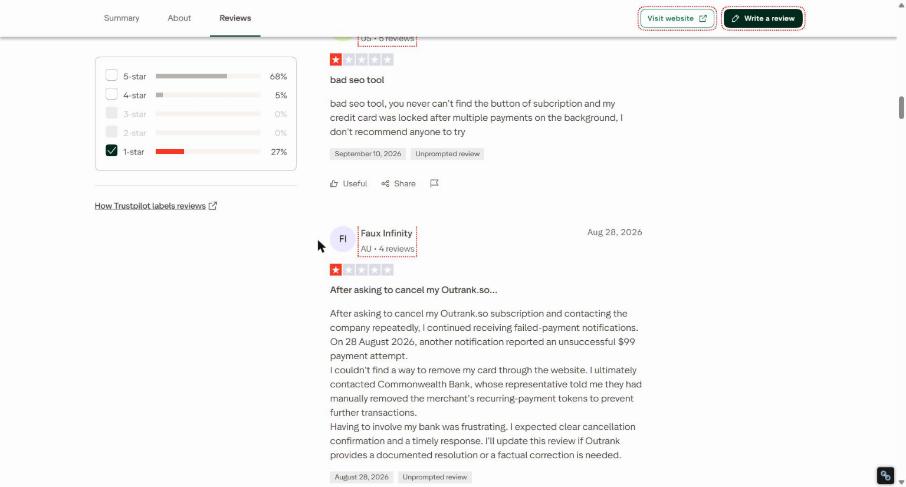
Cancellation and billing complaints cluster in public reviews.
On Trustpilot, Outrank holds a 3.8 out of 5 from 97 reviews (checked October 2026) — 68% five-star and 27% one-star, with almost nothing in between. The negative reviews cluster around a consistent theme: the subscription management page is reported as "unavailable while we research keywords for your content plan" during onboarding, charges continue after cancellation requests, and multiple reviewers describe having to contact their bank directly to block further payments.
One reviewer on WordPress reported a sharp drop in Google Search Console impressions and search visibility immediately after enabling Outrank's automated publishing workflow. The correlation was direct enough to be specifically noted.
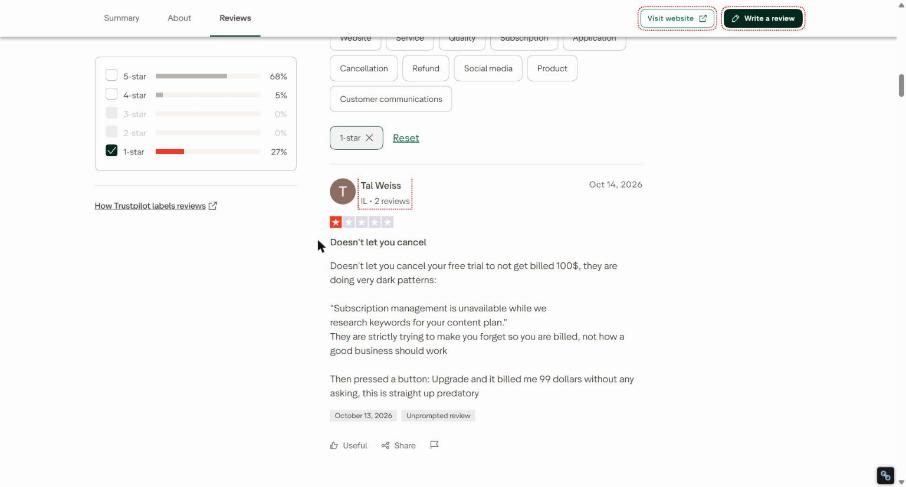
These aren't complaints about content quality. They are specifically about the friction of leaving — which matters when you're deciding whether to start.
Outrank Alternatives at a Glance
Tool | Best fit | Honest note |
|---|---|---|
Keytomic | Approval-first, connected SEO execution | Pro covers one site |
Rankvia | Search opportunity planning + AI visibility | Per-site pricing — verify page capacity |
Seobox | Research, verification, and autonomous publishing | Pricing not publicly listed |
hrefStack | GSC-led, approval-based SEO workflow | Confirm agency and multi-site limits |
Surfaceable | AI buyer-journey visibility and loss analysis | Measurement tool, not content production |
SEORankar | WordPress-first content automation | API model costs sit outside the subscription |
Alli AI | Sitewide technical SEO deployment | Technical layer — pair with a content tool |
Distribb | Buyer-intent research and distribution | Also runs a backlink exchange |
RankYak | Content, backlinks, and page maintenance | Also runs a backlink exchange |
Search Atlas | Broad agency SEO platform | AI visibility gated by plan tier |
1. Keytomic — Approval-First SEO Automation
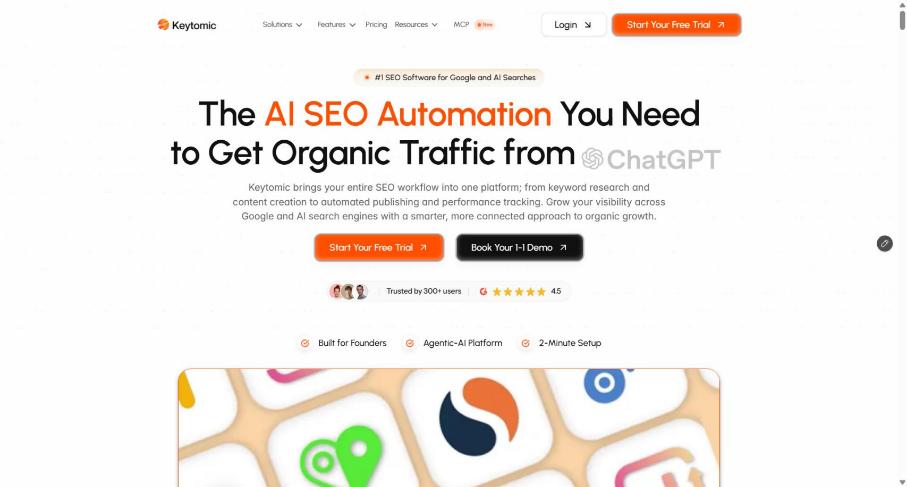
Keytomic replaces the auto-publish default with approval required. Drafts do not leave the platform until a human signs off — that's the structural difference from Outrank, and it applies at $99 per month, not $1,399. The full Keytomic vs Outrank comparison covers the workflow differences in detail.
The execution sequence runs: AI keyword research → topical map generation → content planning → draft creation → human approval → CMS publishing → technical SEO audit → AI search visibility monitoring. Supported platforms: WordPress, Webflow, Shopify, and Framer. See the full integrations list.
Backlink workflows are handled through a backlink profile audit that surfaces opportunities — no credit exchange.
Best for: Teams leaving Outrank over the auto-publish default who want full SEO execution — research, content, technical audits, and AI visibility — gated by human approval at each stage.
What it automates: Keyword research, topical maps, content planning, AI-assisted drafting, internal linking, CMS publishing, technical checks, AI search monitoring.
Honest limit: Pro plan covers one project or site with up to three seats. For agency portfolios or fully managed workflows, see Agency DFY at $999/month or contact Keytomic directly. See also Keytomic pricing.
2. Rankvia — Search Opportunity Planning and AI Visibility
Rankvia starts from documented search opportunities, not a keyword list fed into a generator. Each piece of content ties to a Page Plan, a defined opportunity with a business rationale — before any writing begins. That planning-first structure is the core differentiator.
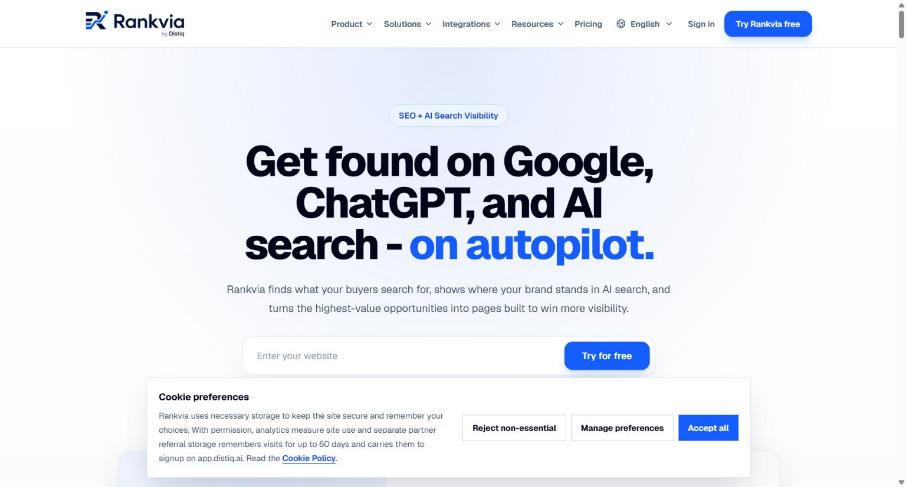
The official site lists search opportunity discovery, a content calendar, a review workflow, AI visibility tracking, and WordPress and Shopify publishing. Technical SEO and backlink workflows are not prominently featured.
Best for: Teams where the planning layer is where value gets added — where identifying the right opportunity matters more than publishing speed.
What it automates: Opportunity discovery, content calendar planning, Page Plans, draft creation, publishing to WordPress and Shopify.
Honest limit: Priced per website by monthly page capacity. Match that capacity to your actual publishing volume before comparing it against a per-article plan. A higher page-capacity price with built-in planning may cost less in total editorial hours than a cheaper plan where research is done manually.
3. Seobox — Research, Verification, and Autonomous Publishing
Seobox builds fact verification into the content pipeline explicitly — a step most content automation platforms skip entirely. It also lists GEO (Generative Engine Optimization) scoring alongside standard SEO, suggesting content is optimized for AI answer inclusion, not just traditional rankings.
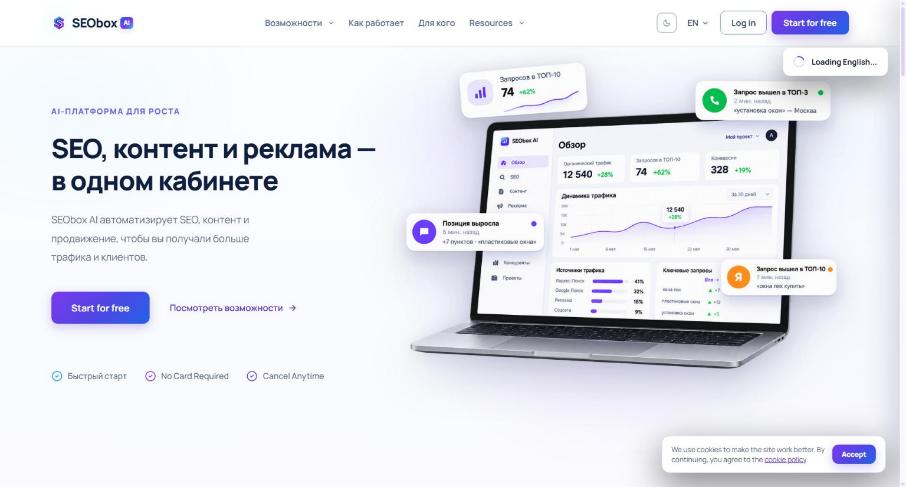
The platform covers keyword research, a content pipeline, fact-checking, SEO and GEO scoring, AI visibility probing, an approval queue, and CMS publishing.
Best for: Teams frustrated by both Outrank's auto-publish default and by content that doesn't pass a basic factual accuracy check — who want those quality controls built into the automated flow rather than layered on manually.
What it automates: Keyword research, fact verification, SEO and GEO content scoring, approval queue management, CMS publishing.
Honest limit: No public pricing was listed on official pages at the time of review. Confirm plan limits, your exact CMS connection, and whether the approval queue is the default behavior or something you have to configure before committing.
4. hrefStack — GSC-Led, Approval-Based SEO Execution
hrefStack builds its workflow around Google Search Console data and competitor gap analysis, not a keyword list. Articles are generated from signals about what's actually performing — or underperforming — on your site. Human approval is required before anything publishes.
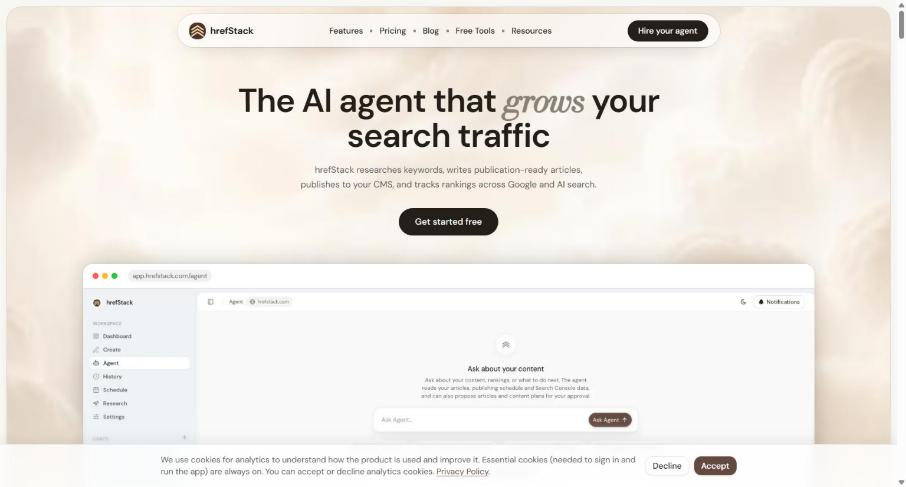
The platform also describes persistent brand context: the tool learns your voice and applies it consistently across drafts. A combined AI and Google visibility view in one dashboard is listed.
Best for: Teams leaving Outrank specifically because content feels disconnected from their own search data — who want drafts that start from real GSC performance signals rather than a topic brief.
What it automates: GSC data analysis, competitor gap research, content generation, brand-voice quality scoring, CMS publishing.
Honest limit: Pricing, agency limits, and multi-site separation weren't listed on the official pages reviewed. Ask directly about those before assuming they exist.
5. Surfaceable — AI Buyer-Journey Visibility
Surfaceable doesn't produce content. It simulates the buyer journey — the sequence of questions a prospect asks from awareness through to a purchasing decision — and shows where your brand enters, exits, or loses ground in AI answers at each stage.
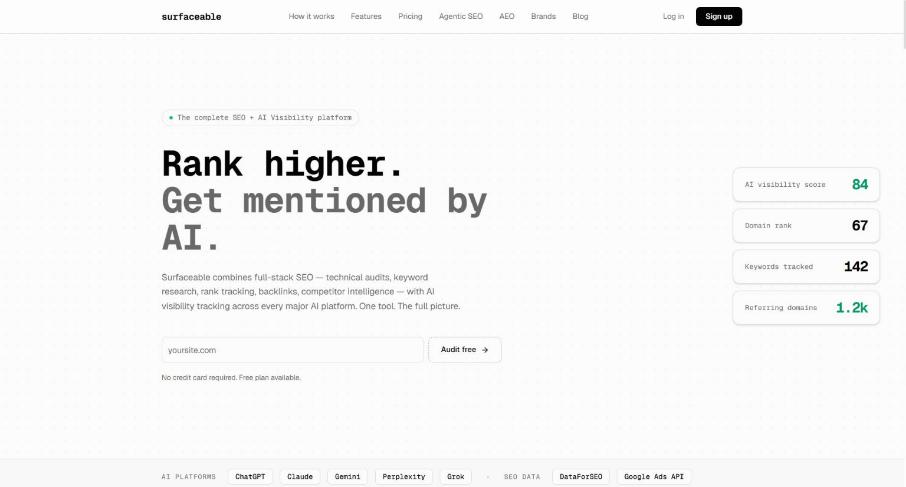
That's a different measurement than "are we mentioned in AI results." Surfaceable shows where you drop out of the conversation, which is where brand positioning problems actually surface in AI-assisted research. Keytomic's AI visibility tracker covers a similar space for teams who want visibility monitoring inside the same platform they use for content and technical SEO.
Best for: Teams whose primary gap is understanding how AI assistants position their brand across a real buying journey — not teams looking to replace content production.
What it automates: Multi-turn AI buyer-journey simulation, competitor mention tracking, AI citation loss analysis.
Honest limit: Surfaceable appears under two domains (surfaceable.io and surfaceable.ai) with different emphasis — confirm which product you're evaluating. Publishing workflows are not listed. This is a measurement tool; pair it with a content production platform.
6. SEORankar — WordPress-First Content Automation
SEORankar breaks content generation into 21 discrete steps, giving teams visibility into exactly where in the process an article currently sits — research, drafting, optimisation, or publishing — rather than treating generation as a black box event.
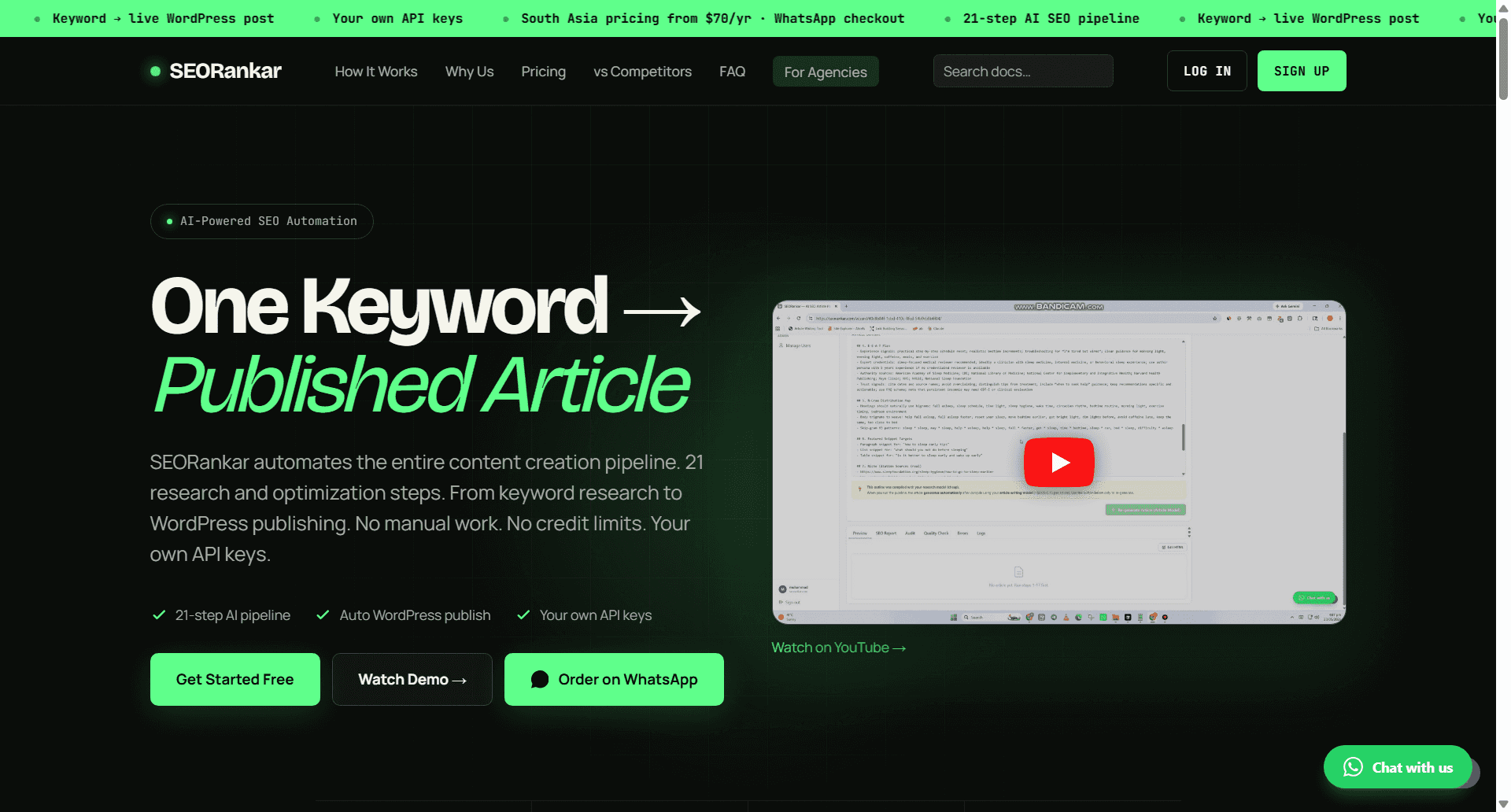
WordPress publishing with RankMath integration is confirmed. The bring-your-own-API-keys model means you control which AI models are used and can switch to better models as they release, without waiting for the platform to update its backend.
Best for: WordPress operators who want a structured, step-by-step content pipeline with direct control over the AI models behind the output.
What it automates: 21-step keyword and content research pipeline, AI content drafting, RankMath optimization, WordPress publishing.
Honest limit: Model usage costs sit outside the subscription — calculate your total spend before comparing against a per-article plan. Non-WordPress CMS support was not confirmed on the pages reviewed.
7. Alli AI — Sitewide Technical SEO Deployment
Alli AI is a technical and on-page SEO deployment tool, not a content production platform. It pushes on-page changes — title tags, meta descriptions, headings, schema — live through a script or CMS integration, without a developer. It also lists AI crawler support, a layer most content tools don't address.
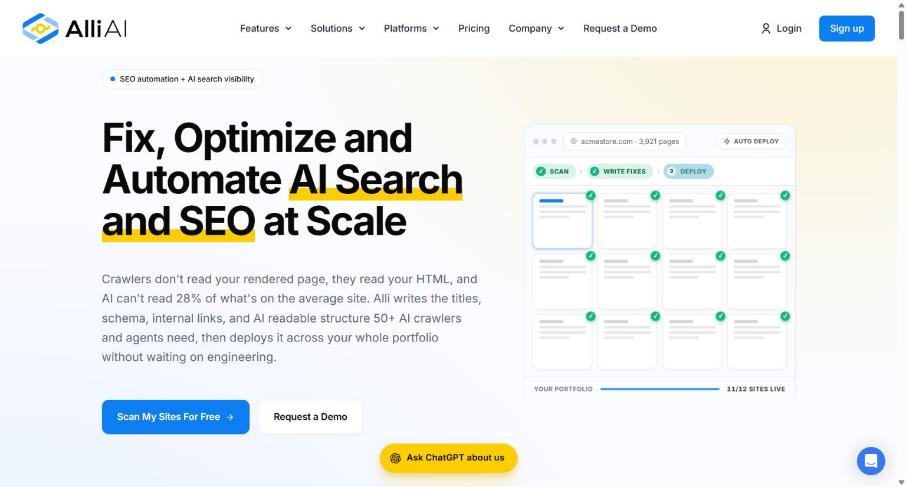
AI crawler access configuration matters before any AI visibility measurement is meaningful. If your site's appearance in AI answers is a priority, how those crawlers read your content has to come first.
Best for: Teams blocked by developer availability on technical SEO changes, or teams where AI crawler configuration and sitewide on-page deployment are the first priority.
What it automates: On-page changes (titles, meta descriptions, headings), sitewide technical deployment, rank tracking, AI crawler access management.
Honest limit: Content planning, topical maps, and a content calendar are not listed. Pair Alli AI with a content production tool — it's the technical layer in the stack, not a standalone Outrank replacement. See also: Keytomic vs Alli AI. For agencies, compare plan limits carefully against your portfolio size.
8. Distribb — Buyer-Intent Research and Wide Distribution
Distribb covers research, writing, CMS publishing, a backlink workflow, and social distribution from one platform. The source-backed content claim is the differentiator worth testing: content is positioned as grounded in verifiable sources, not just generated from a brief.
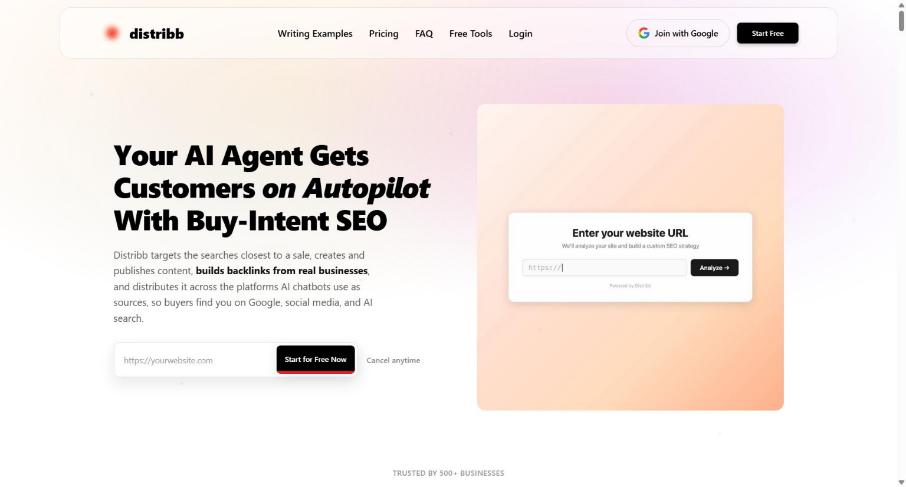
Worth noting clearly: Distribb runs a backlink exchange. If leaving Outrank's exchange model is your primary reason for switching, this is a like-for-like swap on that dimension.
Best for: Teams that want research, publishing, and distribution handled together — not just content production, but getting articles placed across multiple channels.
What it automates: Buyer-intent research, source-backed drafting, approval workflow, CMS publishing, backlink exchange, social distribution.
Honest limit: Pricing was not listed on accessible official pages at the time of review. The backlink mechanism is a credit exchange, not an opportunity model — confirm the terms before committing.
9. RankYak — Content, Backlinks, and Page Maintenance
RankYak covers keyword discovery, topical maps, content planning, publishing, a backlink exchange, and ongoing page maintenance through Site Guard and Page Guard. The maintenance features are the differentiator: most content automation tools are built entirely around creating new content. RankYak has specific tooling for monitoring and protecting existing pages over time.
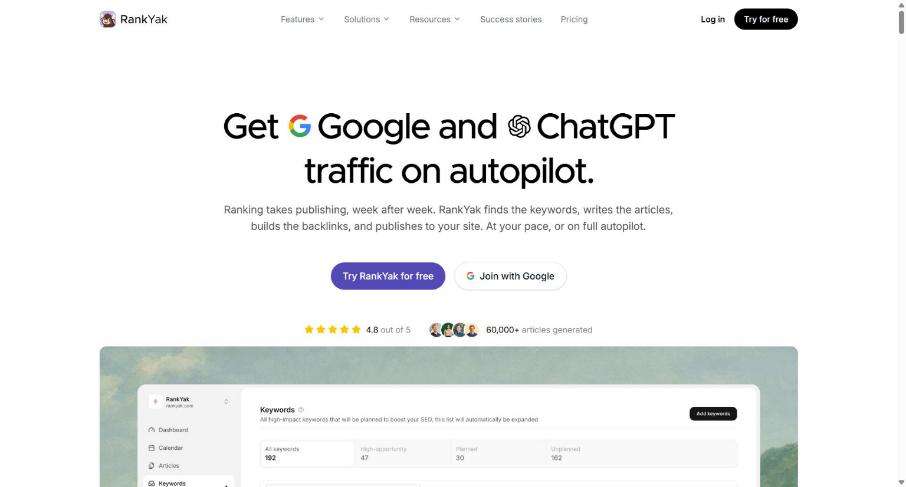
Note: RankYak also runs a backlink exchange. If you're leaving Outrank specifically to exit that model, RankYak is a direct swap on that dimension, not an exit.
Best for: Small teams that want planning, publishing, and ongoing page maintenance from one tool, and who are comfortable with a backlink exchange mechanism.
What it automates: Keyword research, topical maps, content planning, CMS publishing, backlink exchange, ongoing site and page monitoring.
Honest limit: No public pricing was listed on official pages reviewed. Confirm the backlink exchange mechanics and agency support directly before committing. See also: Keytomic vs RankYak.
10. Search Atlas — Broad Agency SEO Platform
Search Atlas is the broadest tool on this list — SEO research, content, technical SEO, and agency reporting from one platform. Among the alternatives here, it's one of the few that can realistically cover all of those functions at meaningful depth without a second vendor relationship.
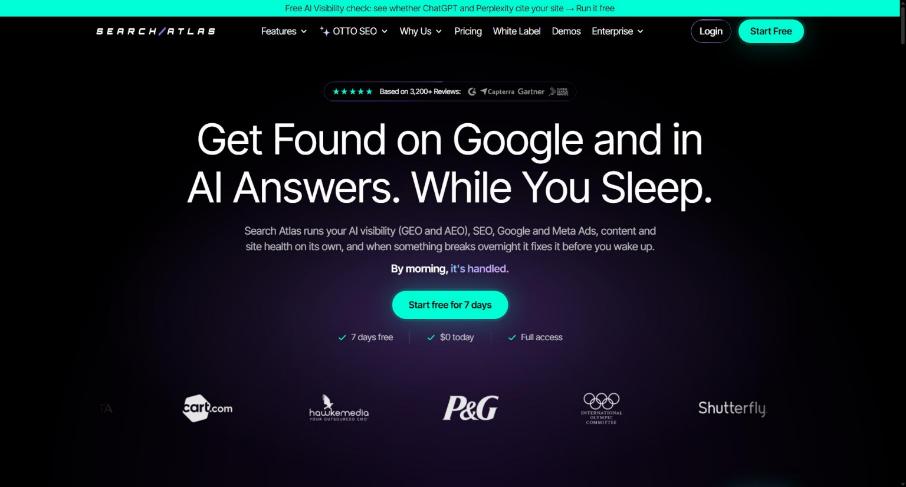
AI visibility tracking and white-label reporting exist but are gated behind plan tiers. The question isn't whether the features exist — it's whether the tier that includes what you actually need fits your budget.
Best for: Agencies or larger in-house teams wanting one platform for research, content, audits, and client reporting without managing multiple vendor relationships.
What it automates: Keyword research, content planning and generation, CMS publishing, technical audits, rank tracking, agency reporting.
Honest limit: AI visibility coverage and white-label reporting depend on plan tier. A broad platform covers more ground but may charge for modules you won't use. Compare against your specific bottleneck before committing. See also: Keytomic vs Search Atlas.
How We Ranked These Alternatives
We didn't rank by feature count or headline price. We ranked by workflow fit against the specific structural reasons teams leave Outrank.
The primary filter: does the tool solve one of Outrank's structural limitations — approval controls, backlink exchange, CMS coverage, technical SEO alongside content, or AI visibility tracking — without creating a comparable constraint? Tools that only moved the problem sideways (like swapping a backlink exchange for another backlink exchange) are noted honestly. Tools that close the structural gap without requiring a separate vendor for each function scored higher.
Secondary filters: whether approval is a default behavior or something you have to find and configure, pricing transparency, confirmed CMS coverage across the platforms our readers actually use (WordPress, Webflow, Shopify, Framer), and agency or multi-site capacity.
Conclusion
Every team searching these alternatives is paying for the same thing: removing a manual bottleneck from their SEO workflow. The difference is which bottleneck they're removing.
Outrank removes you from the loop entirely. If you want back in — to approve drafts before they publish, own your link profile, or understand how AI assistants position your brand to buyers — the tools above each give you a different re-entry point. Some replace Outrank's full stack. Some cover one specific layer better than anything else on the list.
Pick the tool that closes your most expensive manual handoff. Verify CMS connections, pricing mechanics, and whether approval is the default or a setting. Run one topic end to end before migrating at scale. That sequence — bottleneck first, tool second — cuts through more noise than reading feature comparison tables alone.