The Bing AI Performance report shows how often Microsoft Copilot, Bing's AI summaries and select partner AI experiences cite your pages, and the grounding queries behind those citations.
Since June 16, 2026, it also labels grounding queries by intent and topic, shows Citation Share, and compares periods. In October 2026, Microsoft added a Topics Portfolio beta that surfaces queries where other sites are cited but yours is not.
It has no click data and no per-channel filter. Pair it with Search Console's Generative AI report and GA4.
The best use is a weekly 30-minute review that turns low Citation Share and missed opportunity queries into page updates.
For years, checking whether AI assistants cited your content meant running prompts by hand or trusting third-party scrapers. On February 10, 2026, Microsoft launched the AI Performance report in Bing Webmaster Tools as a public preview, the first first-party report on AI citations from a major search engine.
Eight months on, the report has grown. Microsoft added intent and topic labels, Citation Share and period comparison in June, then a Topics Portfolio beta in October. Google has also shipped its own AI report in Search Console. This guide covers where to find Bing's report, what each metric means, and a weekly routine for acting on it.
Bing also powers results for engines such as Yahoo and DuckDuckGo, which makes it a bigger channel than its own market share suggests. See Bing among Google alternatives.
What Is the Bing AI Performance Report?
The AI Performance report is a dashboard in Bing Webmaster Tools that tracks citation visibility: how often your pages are used as sources in AI-generated answers across Microsoft Copilot, Bing's AI summaries and select partner integrations. Microsoft notes the data is aggregated and sampled, not a full log of every answer.
It answers a different question from a classic search report. Instead of "where do we rank?", it asks "is our content being used as a source when AI writes an answer?" Microsoft frames it as an early step toward generative engine optimization tooling.
Two limits to know up front. You cannot filter results by a single surface, so Copilot and partner citations are blended. And the partner integrations themselves are not named.
Where to find the AI tab in Bing Webmaster Tools
Sign in to Bing Webmaster Tools with a Microsoft, Google or email account.
Select your verified site. If it is not verified, add it or import it from Google Search Console.
Open the AI Performance report from the left navigation, or go directly to bing.com/webmasters/aiperformance.
New sites can take around a day before data starts to appear, and low-citation sites may see sparse data or fewer tabs at first. Missing data is not a penalty.
The Metrics in the AI Performance Report
Every metric here measures citation frequency. Microsoft is clear that none of them indicate ranking, authority or the role a page played in a specific answer.
Metric | What it measures | What it does not tell you |
|---|---|---|
Total citations | Times your site appeared as a source in AI answers during the date range | Placement, prominence or whether the link was clicked |
Average cited pages | Daily average of unique URLs from your site that were cited | Which pages matter most commercially |
Grounding queries | Sample phrases the AI used to retrieve content it then cited | The full query set or the user's exact words |
Page-level citations | Citation counts for each URL, with its grounding queries | Why one page is cited more than another |
Visibility trends | Citation activity over time | Traffic, conversions or revenue |
Intents (June 2026) | Grounding queries grouped into categories such as Informational, Commercial, Navigational, Learn and Solve, Research, Creation and Local | Buyer stage inside your own funnel |
Topics (June 2026) | Related grounding queries grouped into thematic clusters | Topics where you are not cited at all |
Citation Share (June 2026) | Your share of all citations shown for a specific grounding query | Competitor names or traffic share |
Compare (June 2026) | How citation activity changed between periods | What caused the change |
Topics Portfolio (October 2026, beta) | Topic size, number of sites cited and query count per topic, plus Top Opportunity Queries where other sites are cited and yours is not | Exact citation volumes; figures are approximate and shown as ranges |
The Pages view is the quickest way to see whether citations cluster on a handful of URLs or spread across the site. If three posts account for most citations, study what they share before writing anything new.
How Grounding Queries Work
Grounding queries are not what users type into Copilot. They are grouped search phrases Bing's AI uses to find candidate sources before it writes an answer, and the report never exposes individual prompts.
A user asks Copilot something conversational, such as "What's the best way to recover from a Google core update?"
The AI turns that into retrieval searches, such as "Google core update recovery strategies" or "core update SEO fixes".
It searches Bing's index with those phrases.
Pages that match those phrases well, and answer them clearly, become candidates for citation.
The relationship is many-to-many: one phrase can map to several of your pages, and one page can appear under several phrases. That mapping is where the useful analysis starts.
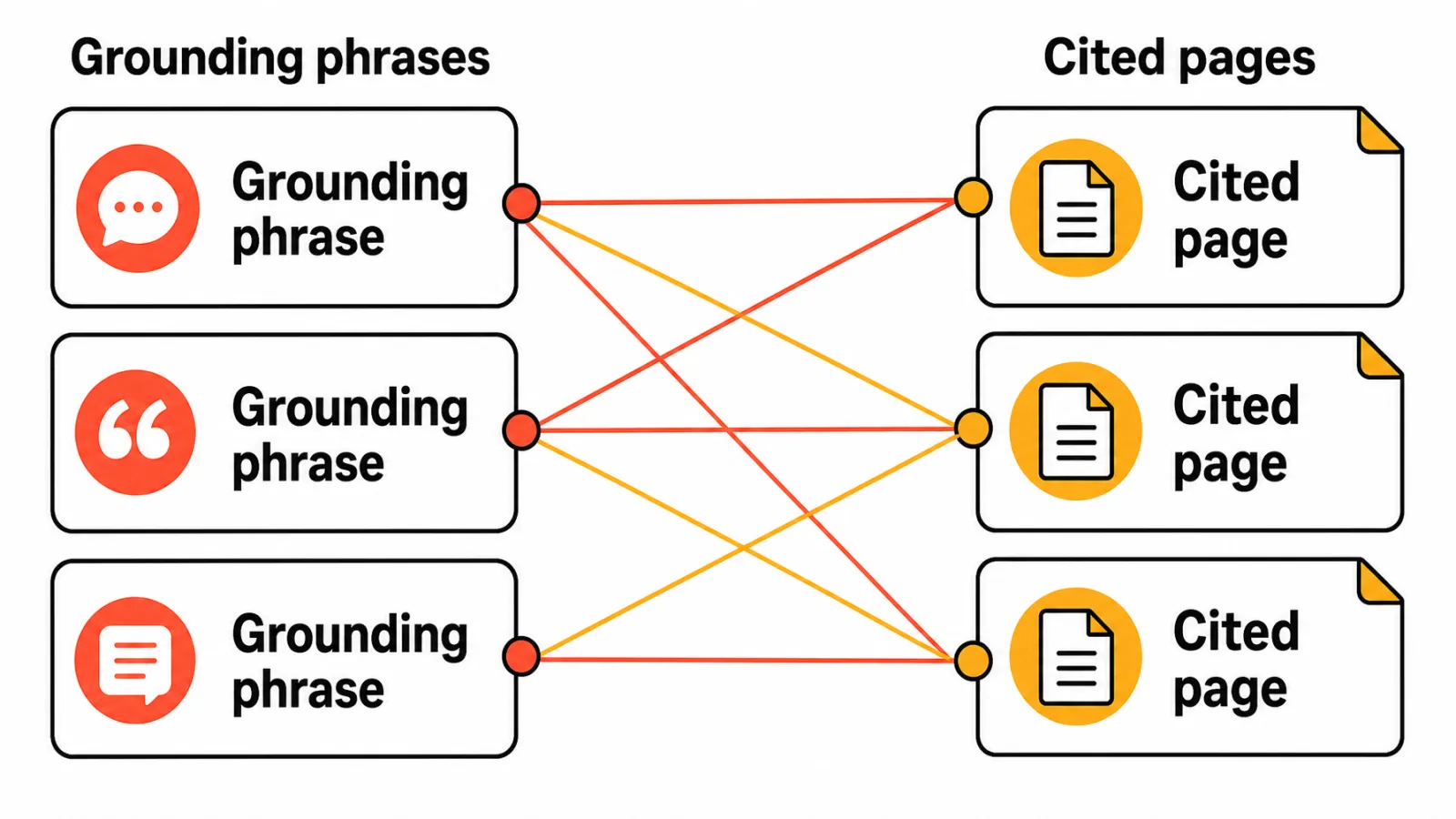
This is the same fan-out pattern Google describes for AI Overviews, which makes grounding queries the most direct public look at how an AI system searches for sources. Treat them as keyword research: if "multilingual SEO strategies" keeps appearing for one of your pages, use that phrasing in the relevant heading and opening paragraph. For the wider picture, see our AI search ranking guide.
What Citation Share Adds
Citation Share turns a raw count into a relative measure. If your site received 3 of the 10 citations shown for a grounding query, your Citation Share is 30%.
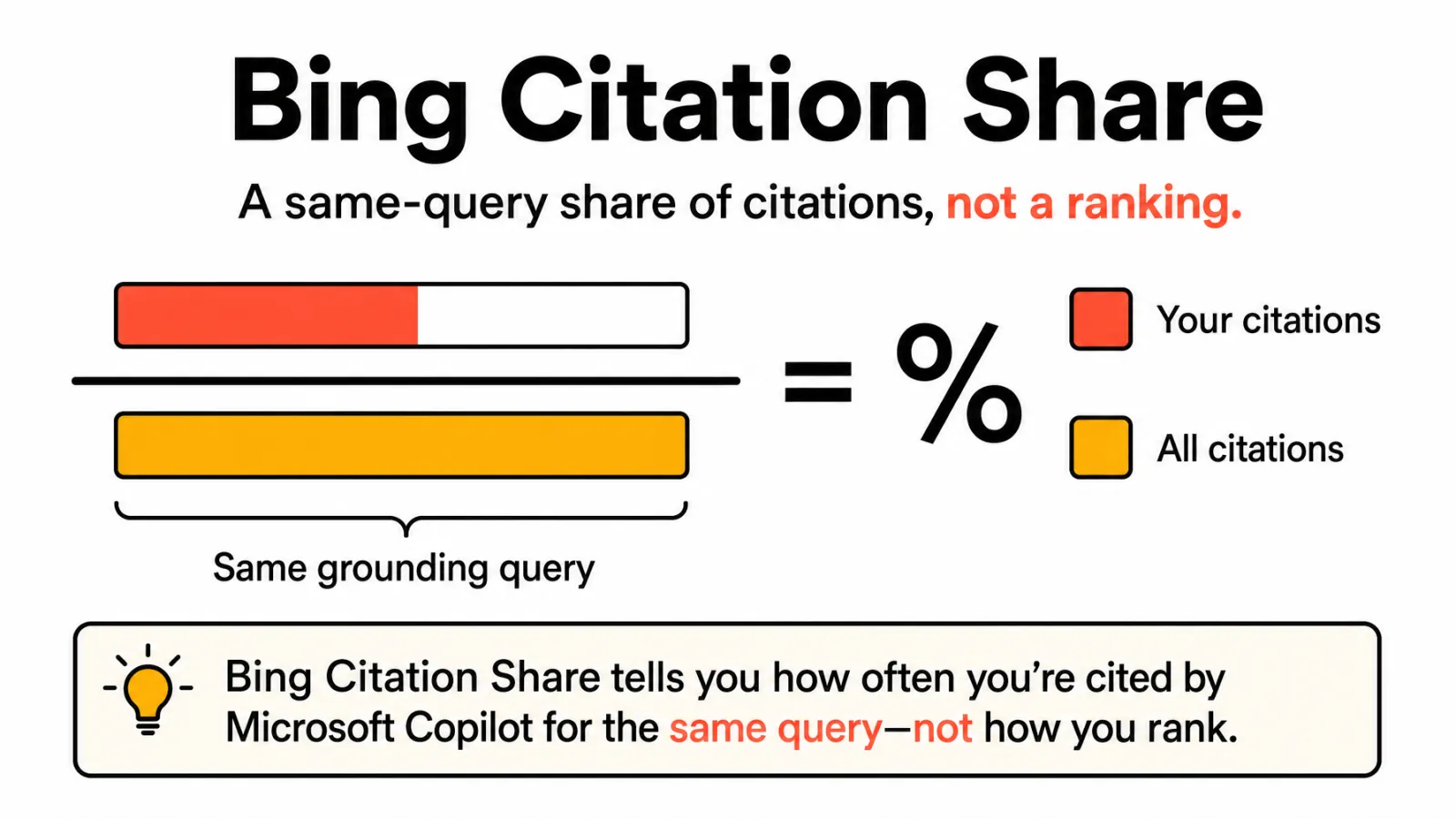
That matters because a citation count alone cannot tell you whether you are winning a query or barely present. Sort by intent first, then by Citation Share, and the priorities appear:
High intent, low share: your best opportunities. A commercial or comparison query where you hold a small slice is a ready-made content brief.
High intent, high share: protect these pages. Keep them fresh and avoid restructuring them casually.
Low intent, high share: good for awareness, but rarely the place to invest next.
Because the denominator changes by query, a 30% share on a narrow query and a 30% share on a broad one are not the same thing, so never average them into one site-wide score. Microsoft describes Citation Share as an observational metric, not a ranking system or competitive scoreboard. It does not expose competitor domains or represent traffic share, and it moves with model changes, competing content, freshness and demand.
A Weekly 30-Minute Workflow for the Report
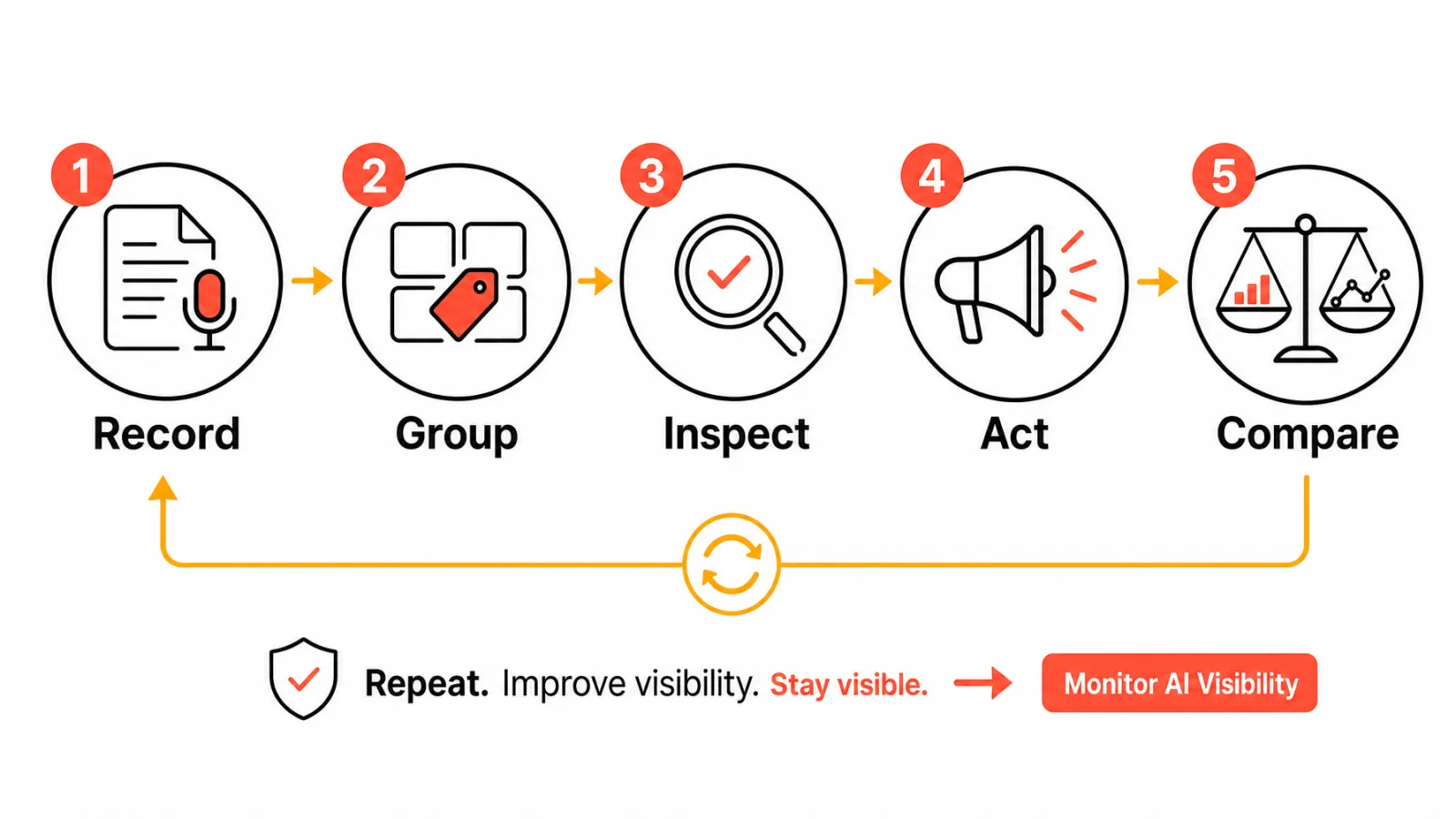
Export the grounding queries. The table exports to a spreadsheet for sorting and filtering.
Filter to Commercial and comparison-style intents first. These map closest to pipeline.
Sort by Citation Share, lowest first. Flag queries where you are cited but hold a small share.
Check Top Opportunity Queries in Topics Portfolio, if your site has enough data to show it. These are queries in your topics where other sites are cited and you are not. Branded queries can show up here, so filter them out.
Open each flagged query to see its cited pages. If two of your pages are cited for the same grounding query, check for duplicate intent and consolidate.
Map uncovered phrasing to existing pages. Add a section or sharpen a heading. Do not create a new page for every grounding query.
Use Compare to check last month's updates before repeating the same kind of change, and log anything else that changed in the same window.
Cross-check traffic in GA4 from copilot.microsoft.com and bing.com referrals.
If you run programmatic SEO templates, the Pages view also shows whether template pages earn citations or only the hand-written ones do.
The Big Gap: No Click Data
The report shows citations, not clicks. A page cited 200 times might send 50 visitors or none, depending on how fully the answer resolved the question and whether the source link was visible.
For agencies, that creates a reporting gap. You can show a client that Copilot cited them 400 times this month, but you cannot tie that to leads from this report alone.
The workaround is manual but workable. Track referral sessions from copilot.microsoft.com and Bing in GA4 alongside citation volume, and add both to your SEO performance trend reporting.
Bing vs Google: AI Reporting Side by Side
Both engines now report on AI visibility, but they measure different things.
Bing AI Performance report | Google Search Console Generative AI report | |
|---|---|---|
Launched | Public preview February 10, 2026 | Announced June 3, 2026; all sites from August 31, 2026 |
Surfaces covered | Copilot, Bing AI summaries, select partners | AI Overviews, AI Mode, Discover AI features |
Core measure | Citations | Impressions |
Breakdowns | Grounding queries, pages, intents, topics | Page, country, device, date |
Relative measure | Citation Share per grounding query | None |
Opportunity view | Topics Portfolio beta (October 2026) | None |
Period comparison | Compare (June 2026) | Date ranges |
The short version: Bing gives you more detail on how AI retrieves and cites your pages, while Google gives you volume on the larger engine. Use both, and add a third-party tracker for ChatGPT, Perplexity and Gemini, which offer no webmaster reporting. For Google's side, see how to rank in Google AI Overviews.
Local Businesses: Keep Bing Places Accurate
Microsoft pointed to Bing Places for Business when it launched the report. When someone asks Copilot for "an Italian restaurant near me with outdoor seating", answers lean on verified business listings.
If your hours, address or amenities are wrong in Bing Places, you are unlikely to appear. Keep Bing Places, Google Business Profile and your website consistent. Our guide to ranking higher in local listings covers the basics.
How Keytomic Fits Alongside the Bing Report
The AI Performance report lives inside Bing Webmaster Tools. Keytomic covers the steps around it. Details were checked against Keytomic's public pages in October 2026.
Bing data in one workspace: the Bing Webmaster Tools integration brings Bing clicks, impressions, queries, crawl and indexing insights into Keytomic reporting. AI Performance data itself stays in Bing Webmaster Tools.
Faster recrawls: multi-search engine indexing submits new and updated pages through IndexNow, so changes you make from the weekly review reach Bing sooner. Setup on Framer is in our IndexNow guide.
The engines Bing cannot see: the AI Visibility Tracker runs your prompts across ChatGPT, Perplexity and Gemini and records citations and competitors.
To see it on your own site, book a Keytomic demo.
FAQs About the Bing AI Performance Report
What is the Bing AI Performance report?
It is a report in Bing Webmaster Tools that shows how often your content is cited in AI-generated answers across Microsoft Copilot, Bing AI summaries and select partners, along with the grounding queries and pages behind those citations.
What are grounding queries?
Grounding queries are grouped search phrases Bing's AI uses to retrieve candidate sources before writing an answer. They differ from the user's question; for example, "how do I speed up my Shopify store" might ground as "Shopify speed optimization".
What is Citation Share in Bing Webmaster Tools?
Citation Share is the percentage of all citations shown for a grounding query that point to your site. Microsoft added it in June 2026 and describes it as observational, not a ranking or competitive score.
What is Topics Portfolio?
Topics Portfolio is a beta view Microsoft added on October 13, 2026. It groups grounding queries into topics, shows approximate topic size and how many sites are cited, and lists Top Opportunity Queries where other sites are cited but yours is not. It appears only when your site has enough data.
Does the report show clicks?
No. It reports citation frequency only. Use GA4 referral data from copilot.microsoft.com and Bing to estimate traffic.
Is the AI Performance data available through an API?
It was not part of the report at launch. Check the current Bing Webmaster Tools API documentation before building a pipeline around it.
How is it different from Similarweb?
Bing's report is first-party data from Microsoft about citations in its own AI answers. Similarweb estimates website traffic from third-party data. They answer different questions and work best side by side.
Does Google have a similar report?
Yes. Search Console's Generative AI performance report shows impressions from AI Overviews, AI Mode and Discover AI features, and has been available to all sites since August 31, 2026.
Should I care about Bing if most of my traffic comes from Google?
Yes. Bing's grounding queries are the most direct look available at how an AI system searches for sources, and what you learn there often shapes content that performs on other engines too.
Which of your pages hold the most citations right now, and do they match the pages you would want a buyer to land on?